
A convection oven microwave is a single appliance that combines standard microwave heating with a fan and a heating element to circulate hot air. This setup lets you reheat food quickly and also roast or bake it until the outside browns.
Convection microwave basics
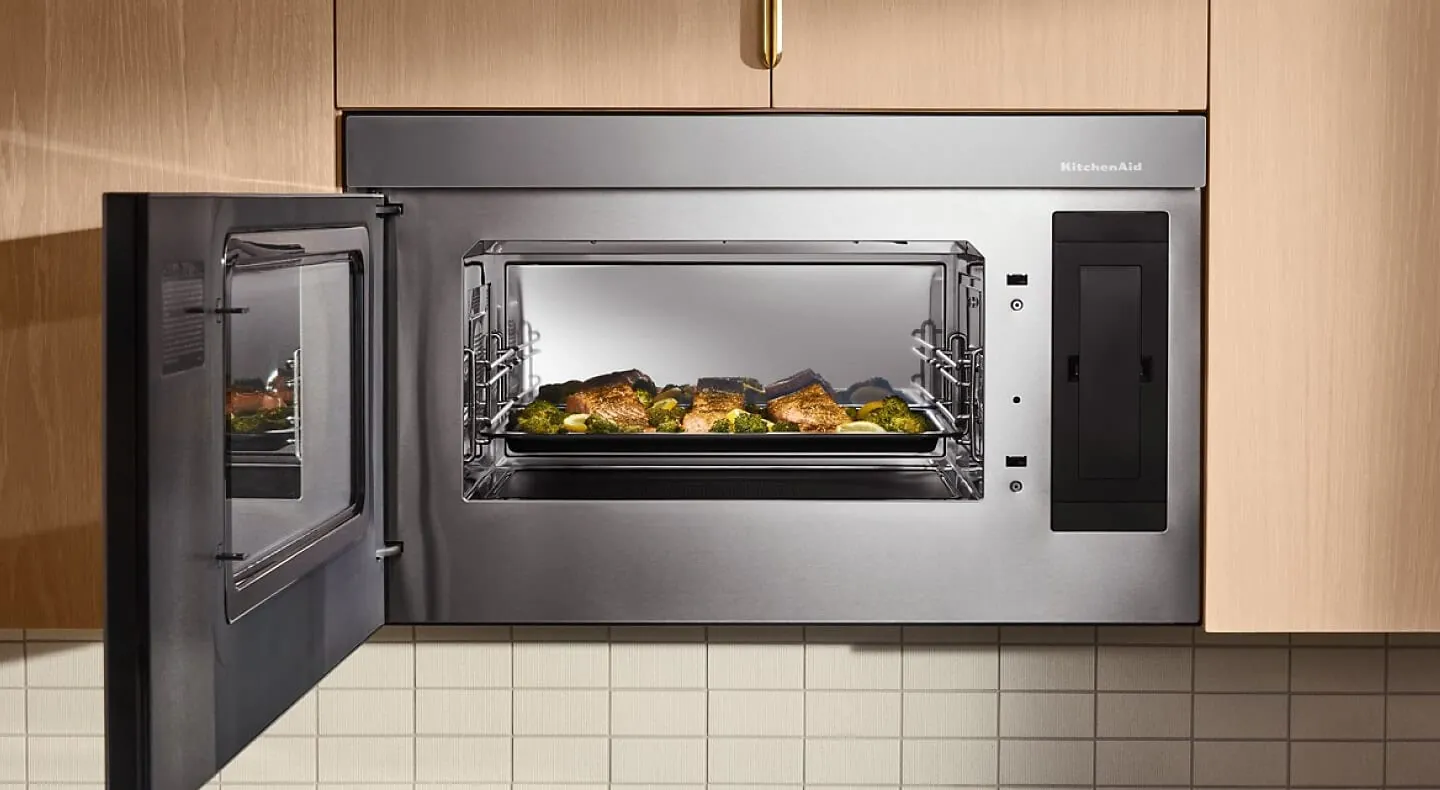
- A convection microwave uses microwaves to heat food fast and a fan to blow hot air around it.
- Microwaves alone don’t brown food; the convection heater and fan create the dry heat needed for a crust.
- These units typically run between 900 and 1,200 watts for microwaving, plus an extra 1,500 to 2,500 watts for convection baking.
- If you just need to warm soup or steam vegetables, use the microwave-only setting; if you want roasted chicken or baked cookies, switch to convection.
- You’ll need metal-safe racks and pans for convection mode, but never put metal inside during microwave-only cycles.
- The internal cavity size usually ranges from 0.8 to 1.5 cubic feet, which limits how large a pan you can fit.
Why convection microwaves brown food
Standard microwaves heat water molecules inside food, capping the surface temperature at the boiling point of water. That’s why microwaved bread stays pale and soft instead of turning crispy.
If you only need to warm liquids or soften butter, the convection feature won’t help you.
When a convection microwave works differently
| Situation | What changes | What to do instead |
|---|---|---|
| Using metal pans | Microwaves reflect off metal | Switch to convection-only mode |
| Reheating liquids | Fan dries out the surface | Use microwave-only setting |
| Baking cakes | Microwave energy makes batter rubbery | Select pure convection bake |
| Roasting thick meat | Microwaves penetrate unevenly | Use convection roast setting |
| Small kitchen counter | Unit needs rear exhaust clearance | Leave 3 inches behind it |
| Cooking raw poultry | Must reach safe internal temperature | Check center reaches 165°F |
How to cook in convection mode
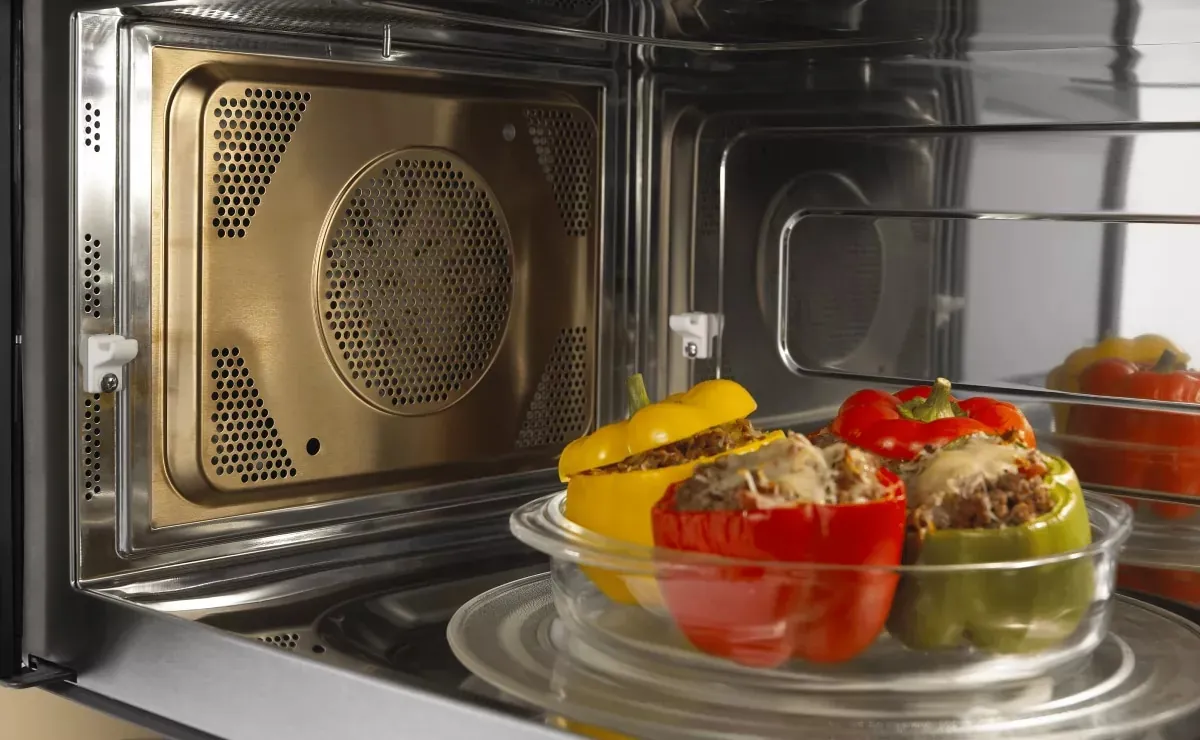
- Remove the glass turntable if your manual says to, then place the provided metal rack inside the cavity.
- Select the convection setting on the control panel and set the temperature, usually between 300°F and 400°F.
- Preheat the empty cavity for about 5 minutes, waiting for the beep that confirms it reached your target temperature.
- Place your food on a low-sided metal or silicone pan so the circulating air can flow freely over the surface.
- Cook the food using the time suggested by your recipe, but start checking about 10 minutes before it should finish.
- For raw meat or poultry, insert a food thermometer into the thickest part to ensure it hits 165°F for poultry or 145°F for whole cuts of beef and fish.
- Let baked goods rest inside the turned-off appliance for 2 to 3 minutes, as the residual heat finishes setting the center.
These times assume a 1,000-watt microwave paired with a 1,500-watt convection element. If your unit runs at 1,200 watts on the microwave side, start checking your food a few minutes earlier. For lower-wattage models around 900 watts, add roughly 10% more cooking time.
Mistakes that ruin convection microwave results
- Using metal pans on the microwave setting. Metal reflects microwave energy, causing sparks that can permanently damage the magnetron.
- Blocking the rear fan vent. Pushing the appliance flush against a wall traps heat, forcing the unit to shut down mid-cycle to protect its electronics.
- Baking cakes with the combination setting. Mixing microwave energy with convection heat causes cake batter to rise too fast and collapse into a dense, rubbery texture.
- Skipping the preheat cycle. Putting food into a cold convection cavity drops the air temperature immediately, resulting in pale, steamed exteriors instead of roasted ones.
- Overcrowding the wire rack. Stacking dishes blocks the fan’s airflow, meaning the top item burns while the bottom one stays raw and cold.
Frequently asked questions
Can you put metal in a convection microwave?
Yes, but only when the appliance is set strictly to convection mode. Metal reflects microwaves and causes dangerous sparking during standard microwave operation. Always check your specific owner’s manual, as some manufacturers restrict certain metals even during convection baking.
Why isn’t my food getting crispy?
You’re likely using the microwave or combination setting instead of pure convection. Microwave energy excites water molecules, keeping the food’s surface moist and preventing crisping. Switch to the convection-only mode and leave space around the food for the fan to circulate hot air.
How long does a convection microwave last?
Countertop models have a shorter lifespan with daily use, though built-in versions often last longer. The magnetron and the convection fan are the parts most likely to wear out first. Your actual lifespan depends heavily on how often you run heavy convection cycles.
Is it safe to cook raw chicken in one?
Yes, provided you cook the chicken until a food thermometer reads 165°F in the thickest part. Don’t rely solely on the color of the juices or the exterior browning. Combination modes can sometimes cook the outside faster than the inside, leaving the center undercooked if you skip the temperature check.
What happens if I use the wrong setting?
Using microwave mode with metal pans will cause arcing and can destroy the appliance. Using combination mode for delicate baked goods like soufflés will make them collapse. The control panel usually locks out incompatible settings, but always verify your mode matches your cookware before pressing start.
Does it use more electricity than a regular microwave?
Yes, because it powers both a magnetron and a heating element with a fan. A standard microwave might draw 1,000 watts, while a convection model pulls an additional 1,500 watts or more during baking. However, it still uses less total energy than heating a full-sized conventional wall oven.
Do I need special pans for it?
You need pans that match the mode you’ve selected. Glass, ceramic, and microwave-safe plastics work for standard microwaving. For convection mode, use metal, silicone, or oven-safe glass. Avoid pans with high sides that block the fan’s airflow, as they prevent even browning across the food’s surface.